Heart to Heart Foundation, with the support of the Korea International Cooperation Agency (KOICA),
is implementing the Community-Driven Integrated Water, Sanitation, and Hygiene (WASH) Improvement Project in Malawi (2025–2027).
On December 3rd, the annual WASH Forum was held in Zomba District, Malawi.
* What is the WASH Forum?
The WASH Forum is a platform where local governments, international NGOs, and community leaders engaged in improving water supply, sanitation facilities,
and hygiene practices come together to share experiences and explore more effective solutions.
Heart to Heart Foundation Presenting a Case Study
The theme of this year’s forum was:
“Innovative, resilient and sustainable WASH infrastructure: a way of life.”
This theme emphasized the importance of WASH approaches that go beyond short-term infrastructure installation
and become fully integrated into the daily lives of community members.
Notably, this year’s forum marked a significant milestone as it expanded beyond a single organization-led event into an officially hosted
forum by the Zomba District local government,
demonstrating concrete progress toward the sustainability of WASH initiatives in the region.
[Why Is the WASH Forum Important?]
Heart to Heart Foundation Staff Explaining the Ongoing Project
Zomba District faces multiple WASH challenges, including water scarcity, aging sanitation facilities,
and inadequate operation and maintenance systems.
This forum was designed not merely as an information-sharing event, but as a space to:
Share successful field-based practices,
and Jointly discuss realistic challenges encountered during project implementation,
in order to identify sustainable, context-specific solutions suited to local conditions.
[Key Discussion Themes of the Forum]
Discussions during the forum centered on the following five core themes:
Encouragement speech delivered to participants by the Zomba District Commissionoer, Ms. Reignard Chavula
1. Ensuring WASH sustainability through sanitation marketing and climate-resilient sanitation facilities
2. ICT-based WASH data management and monitoring
3. The role of local leadership and governance in sustaining WASH outcomes
4. Resource mobilization strategies for safe and sustainable water supply
5. Strengthening community engagement and risk communication
A traditional leader, Mr. Kind Rajab, sharing experiences of applying best practices learned from other regions
The role of traditional leaders and local government was a focal point of the forum discussions.
Mr. Kind Rajab, a traditional leader from the Ching’anda area, shared his experience in achieving Open Defecation Free (ODF) status
and emphasized that traditional leaders must stand at the center of change.
He stressed that leaders should move beyond receiving reports and instead actively lead field inspections and follow-up actions,
fostering community-led monitoring and improvement systems.
Such leadership, he noted, helps reduce excessive dependence on government or NGOs
and is the most critical factor in ensuring sustainability.
Additionally, the District Health Office (DHO) delivered a presentation on strengthening WASH monitoring through ICT.
The office highlighted that current WASH data management remains largely NGO-driven,
limiting long-term sustainability within government systems.
To address this, local authorities emphasized the importance of systematic data management using ICT tools such as mWater
and enhanced information sharing among NGOs as key components for future policy formulation and program improvement.
Presentation by Another NGO (Water For People)
Discussions with other NGOs and community members further underscored
that for integrated approaches—linking sanitation markets, village savings and loan groups,
and Water Point Committees (WPCs)—to function effectively, strategies must comprehensively consider:
- Household financial accessibility
- Timing of income generation
- Community understanding of projects
- Capacity of responsible public officials
- Monitoring and operational systems
[WASH Solutions in Practice: Pavilion Exhibitions]
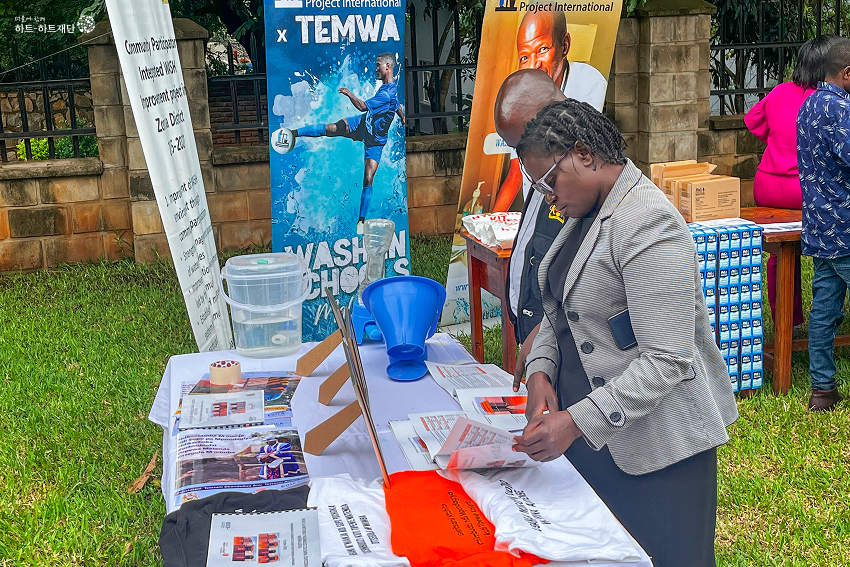
At the forum venue, Heart to Heart Foundation and other WASH organizations showcased practical WASH solutions
currently being implemented in their respective regions through exhibition booths and presentations.
<Heart to Heart Foundation>
Participants Visiting the Heart to Heart Foundation Booth
Heart to Heart Foundation presented:
- Low-cost, context-appropriate sanitation models
- SATO Pan (plastic hygienic toilet pan covers)
- Handwashing facilities
- Disability-inclusive sanitation facilities
These exhibits highlighted sanitation solutions that communities can select, construct, and maintain independently.
One local leader remarked with interest that
“community members are choosing sanitation models that fit their own situations and building them themselves.”
<Villages in Partnership>
Staff from Villages in Partnership presenting their work
Villages in Partnership shared case studies on ecological sanitation (Ecosan) toilets and water facility construction.
While Ecosan toilets have relatively higher initial costs,
they were introduced as a more sustainable long-term alternative compared to traditional pit latrines,
which require reconstruction once pits are filled.
Ecosan systems allow for long-term use and the reuse of human waste as fertilizer, offering both environmental and economic benefits.
Key materials used in Sanitation Models shared by Villages in Partnership
<Fresh Water Project International>
Fresh Water Project International showcased water purification kits, menstrual hygiene kits for schoolgirls, and water treatment equipment,
emphasizing the urgent need to expand menstrual hygiene support and establish stable and sustainable supply systems.
[The Way Forward: Building Sustainable WASH Together]
Forum participants reached a consensus on the following joint action points:
- Expanding access to low-cost sanitation facilities and hygiene products
- Strengthening operation and maintenance systems, beyond mere facility installation
- Institutionalizing local government–led, ICT-based WASH data management systems
- Enhancing linkages between Water Point Committees and local repair technicians
- Promoting financial self-reliance through water-related income-generating activities and community-based savings and loan groups
Participants Engaging in the WASH Forum
This WASH Forum served as a collaborative platform where local government, international NGOs,
and communities came together to build sustainable WASH systems.
Heart to Heart Foundation remains committed to supporting community-driven solutions
and long-term change through continued field-based partnerships and support.
Government Officials and Community Members Attending the WASH Forum
<Heart to Heart Foundation, with funding from the Korea International Cooperation Agency (KOICA),
is implementing the Community participatory Integrated WASH Improvement Project in Zomba District, Malawi>